Effects of a Less Than Optimal Project

Sixth graders did an engineering challenge this year to create the fastest robot they could that could also go around an obstacle placed anywhere and continue along its path.  For this year’s sixth grade students, it was their first year of robotics.  In subsequent years, students will have more and more experience with robotics coming into sixth grade.  I created a survey with 4 parts.

  1. Define Robot (short answer)
  2. Define Engineering (short answer)
  3. I want to be an engineer or scientist when I am older
  4. I like using computers and other technology.

Students answered the last 2 questions using a Likert Scale (Strongly Agree, Agree, Neither Agree or Disagree, Disagree, and Strongly Disagree.)

Being the first year, I did not get this project quite right and it was not optimal (needed more time and/or a simpler challenge). What I found was that there was about same number of kids whose interest in engineering was increased as decreased.  What is significant was that this one project did cause some movement in attitudes.  In contract, interest in technology was virtually unchanged by the project.  I expect to see more positive movement with a better challenge and I also expect that children with much more experience in engineering than these students, who only have 1 year, will be more resilient to temporary frustrations.  We may also find that the more we expose young children to early engineering, even with the best projects, they may find it to be their thing (or not) sooner.

When I asked this year’s sixth graders after the survey about their responses, they said:

  • they felt frustrated because they could not finish,
  • that engineering was too hard (based on this),
  • that engineering was fun but that they would not want to do it full time, that they liked the projects but had stronger interests besides engineering.

It will be interesting to see what happens next year.  I am going to simplify the challenge and also the kids next year will come in with a year of robotics experience.  I also had to give the survey right after the project finished (or not), so next year, I will let some time pass regardless of the my perceived success of the project.

Posted in Robotics, Teaching, Technology | Leave a comment

Kids Engineer Debuts

This is the new home of all blog entries related to work, which will focus on elementary robotics and technology. You can find all my dog training, nature, spirit, and other materials at http://www.jheffernan.com/

Posted in Robotics | Leave a comment

Creative Play and How It Relates to Robotics Education

At the suggestion of a doctoral student I met at a robotics conference, I did a series of interviews with some of my elementary robotics students.  I started a program this year that consists of robotics projects at every grade level from preschool to grade 6.  Additionally, there are open ended engineering challenges, based on robotics, at grades K, 2, 4, and 6.  These consist of challenges like building your own burglar alarm or carnival ride instead of the standard projects where they build a design from the book.

The kids repeatedly said that the projects were fun (this was mentioned some 24 times with the next most common being that they liked that it was hands-on, which was mentioned 13 times.  When I asked them why it was fun, they said because it was hands on or that that it was satisfying at the end or that it was different. I say the same things in my and grant applications:  hands on is better, fun, a good way to learn, etc.

But I was left feeling that I was not getting at the core idea of why it was fun for them.

At the same time, I was editing some videos of my son Aidan.  I try and create a DVD made up of movie clips and a slideshow every 6 months.  Aidan, my wife Dawn, and I love to watch them periodically.  I am fascinated to both see how Aidan has changed and how he stayed the same.

Here’s a clip of my son Aidan playing with some Lego blocks.  I have always loved this creative, dramatic play that he does with blocks.  He also does this type of play in the bath.

I have been thinking that I will miss this when it stops and was assuming it was just something all kids do and all kids grow out of.

But I was out running one day with my dogs and it hit me, that the fun the older kids are having with robotics has a connection to the creative play my son and presumably all kids do.

In kid’s creative play, they create – with blocks or other toys – their own microworlds that they have absolute control over.  The building seem to be in service to or a prelude to the dramatic, creative play that follows.  This dramatic play has characters, plots, and many, many sound effects!  As I watch children PK-6 work with robots, I see aspects of this creative play, especially in open ended challenges where they can build their own design.  I see some of that fade, at least explicitly, over time.  However, I did see, even in this year’s sixth grade class, some Lego characters attached to cars in different ways.

Then, when out a run one day, it hit me that robotics taps into the creative play younger kids do.  Robotics is creative play for older kids.

How much do we tap into this at school?  Not very much!  Students were clear that one of the reasons that robotics was so fun was that it was different, not something they usually do, and where they get to build, and get to do things without teacher help or following directions.  Aren’t those reasons some of the key features of creative play?

I think we tap into some of the creative play instinct in creative writing and art, which tend to be more attractive to girls, speaking very generally.  But very few teachers tap into the (typically boy) activities of blocks and/or Legos.  I always had a take apart center in my third grade classroom, where students could take apart electronics gear and old typewriters.  This attracted many boys, especially those with learning disabilities (LD) and/or attention deficit disorder (ADD).  We have seen the same thing with elementary robotics, where many boys with LD or ADD that do lots of Legos at home can really shine and be stars and helpers in their classrooms where they usually struggle.

I think we are missing many boys in elementary school by not tapping into this creative play instinct.  Somehow, corporations are not missing this point however, by creating and selling billions of dollars of action figures and other toys that do tap into creative play, sometimes in ways that are not as constructive as they could be.  We are not tapping into this at schools, if anything we are actively repressing it.

This Ted Talk by Ali Carr-Chellman does a great job of laying out some of the reasons elementary schools are failing boys.

A teacher I work with has always wondered why games we do such as My Make Believe Castle, SimTown, and SimCity are so popular with kids.  Again, I believe these “god” games, where the player controls their own microworld, tap into the creative play instinct that is so strong in toddlers and preschoolers.

Even though this insight answered many questions for me (and is theory and not proven), many more emerged.

How does this creative play instinct evolve over time?  Are there developmental milestones ala Piaget that are similar for creative play/building/engineering?

How does it fit into Multiple Intelligence Theory?  MI Theory does not seem to have a corresponding intelligence for the creative play/building/engineering that I am talking about.

How does it fit into our aboriginal roots?  Have children always built and played with things in some way?  How has this evolved over time and what survival value did it have originally?

Why do preschoolers and toddlers, who do everything – music, dance, drama, humor, sports, art, language, building, social, nature, spirit – eventually stop doing everything?  Are they forming their identity and self selecting things that correspond to their natural talents and interests?  Are we culturally selecting certain aspects of personality, with only those with very strong inclinations, able to keep those going?  What are the effects of schools valuing some of these over others?

Does the relative lack of engineering and building experiences in elementary schools narrow the pool of students have may had inclinations towards engineering?  By the time they are exposed to engineering in high school (if at all), is it too late?


Posted in Child Development, Robotics, Teaching | Leave a comment

Quotes From Elementary Robotics Students

Here are some key quotes from the robotics interviews I conducted with students this year.  I will discuss them later.  Enjoy.  There are some great quotes that show what this robotics experience is like from the student’s point of view.

What Robotics Is Like And How It Is Different Than Other School Work

It’s more fun to actually be building something.  If you took a class in robots and just learned about things, if the teacher just drilled information into your head, it would not be as fun as building and experiencing it to learn.    Grade 6 Girl 2

Absolutely  [different from other schoolwork.] It’s [robotics] more interactive because mostly what we are doing in school is paperwork.  With this you get to experiment, instead of just doing something, like math, you got a question, you figure it out.  With this you can like, change it up, experiment.  Grade 6 Boy 1


Most people can’t really try and engineer a robot, try and play with it, and make sure it works but we had the chance to do it.  Grade 5 Girls Team 1


I didn’t think you would use all that math and science to build that robot.  Grade 6 Girl 2


It was very interesting that we got to build a real, live robot.  I never imagined I would build a robot.  It was really cool.  Grade 5 Boy 1


It’s more fun [than usual schoolwork.]  It’s a lot different – sometimes mathematical.  You have to think in a different way.  This would make this would make this happen.  Each step is connected.  Grade 4 Boy Team 2

It’s fun because it allows you to challenge yourself in a different way, than just your mind, because you have to be able to figure out how things go together because that’s physical memory.  Grade 6 Boy 1


You can actually do something, not just watch someone else do it.  Grade 5 Girls Team 1


It’s fun and different in a different way.  I just think it is more fun.  The way you think.  Easier is some ways, harder in some ways. The way you think is more fun to think that way than the other way.  Grade 4 Boy Team 2


I do prefer doing Mindstorms or WeDo over just building because I really like programming.  You can think more about what would make something happen if you add gears or other stuff.  Once I make it be able to do something, it’s really satisfying to see things move. It feels good.  It’s cool that you get something to move and that it’s moving because [before] it was just a pile of Legos.  It’s satisfies you once you done with it.  Grade 4 Boy Team 2


I really liked it because it was different, not something that you do everyday with a normal subject, something you look forward to, not something that you do everyday like math and science.  You get to work with your hands a lot.  Grade 6 Girl 1


Robots are something that you don’t learn on a board, you kind of learn by doing it with your hands.  You look at it and observe it more.  Grade 6 Girl 1

It’s more exciting.  It’s special.  Grade 6 Girl 1

I would like to do it longer.  Grade 6 Girl 1

I am really glad that we do have them [robots] at this school.  We have a lot of cool technology stuff that we do here.  I mean, starting younger with computers you get to learn to use the different computers and you get to…  We can program stuff.    You got to try to put [things] together.  Grade 6 Girl 1

I like building.  I never do Legos but it was fun  to figure out how to build them and figure it out on your own without a lot of teaching.  Grade 6 Girl 2

It was just fun to try and figure out something.  It was hard but it was really fun.  Grade 6 Girl 2


This is more fun.  I learn faster on Lego than other subjects.  I find it more interesting.  I can get involved in it really easily.  Grade 6 Boy 1

I learned that you need to use a lot of different skills, from writing to most of the different subjects like math for the programming and other subjects too. Grade 6 Boy 1


Robots aren’t usually something you see around.  These are really simple ones.  When you think about robots, you think about R2D2, movies, and stuff.  They aren’t real but these are.  Grade 5 Girls Team 1

It’s different because you don’t usually engineer things in school.  It is more hands on than the rest of our school work.  [Hand’s on] is more fun and, in certain places, it makes it easier to learn.  Grade 5 Girls Team 1

I like doing Legos without directions because you can’t put things in the wrong spot.  Grade 5 Boy 1

Other schoolwork is more like writing and papers.  [Robotics] is more interactive, hands-on so I like that.  We don’t do it that often so it’s more fun than sitting and doing paper. Grade 4 Girl 1

I like doing the “not following the program” more because you get to make it up.  Grade 4 Girl 1

It’s fun to see what they [robots] do.   Grade 4 Boy 2

I like [open ended challenges] because everyone’s are different and I like having to get new ideas.  Grade 4 Girl 2

I could do it [WeDo] without having to ask grownups all the time and not follow directions.  Grade 4 Boy Team 2


My other schoolwork I could not do all day.  Grade 4 Boy Team 2


I am learning how to program and other things about the computer in a really fun way. Grade 4 Boy Team 2


Building freehand, you’re learning you get to decide what it’s going to do and what it will be like.   Grade 4 Boy Team 2


On the Engineering Design Process


It was hard so it made us jump up and down when it finally worked.  Grade 5 Girls Team 1

We don’t usually build things.  It’s just fun building things and getting things to work and then it does something good at the end.  You feel good about what you made.  Grade 6 Boy 2

It teaches us to keep trying.  Even if you fail, you can succeed if you keep trying.  Grade 6 Boy 1


It’s also about working together to make these crazy, awesome things.   Grade 6 Boy 2

It was pretty fun trying to figure out how some of the pieces of the robot work. Trying to figure out how to make things work.  Nothing usually works the first time.  You usually have to try a few times to get something to work.  I really liked the robots.  It’s fun.  Grade 6 Boy 2

I really liked the way we did it.  We started with the basics at the beginning and moved up to harder stuff and then did the challenge.  Grade 6 Boy 2

Be patient, everything is not going to work the first time.  You just have to keep changing it until it works.  Grade 6 Boy 2

Tiny little things can make big differences.  Grade 6 Girl 1

Don’t copy other people.  Try to do it on your own because you learn more on your own.  Grade 6 Girl 2

Watch your mistakes and how you can improve on them.  Grade 6 Boy 1

You may get frustrated at certain points.  Don’t give up when things aren’t working out.  Grade 5 Girls Team 1

On the paper, we drew out the three different plans.  We thought over which would do the best and which one had the best chance to catch the burglar.  I’m not a big planner but it was good to get your ideas out on paper and see what the different ways were.  Grade 4 Girl 1

It was a challenge to make up my own program.  Grade 4 Girl 1
Posted in Child Development, Research, Robotics, Teaching | 2 Comments

Robotics Interview Data

Here are some preliminary data from the robotics interviews I conducted this year.  I recorded responses when watching the video of the interviews and grouped the same or similar responses together.  There were lots of unique answers and I some of these were very interesting.  I will publish those next as the most notable quotes from the interviews.

What did you like about robotics?

24 Mentioned the project as fun

15 Got to build/hands on

8 Different than other school work/special/exciting

7 Liked the programming even though it was hard

5 Cool

4 It was satisfying/exciting getting things to work

2 Liked the trial and error

2 Had to learn to compromise, work together

2 Got to move around, not stay in seat

What was hard?

4 Being patient

2 Parts falling off

2 Programming

2 Programming sensors

What did you learn?

7 Programming

4 Math

3 Science/how things work

2 Technology

2 Engineering

2 Building

2 Distance = rate x time

Posted in Child Development, Research, Robotics, Teaching | Leave a comment

Robotics Interview Questions

I settled in on these interview questions after some trial and error.

1)   What did you like about project(s) you did this year?  How could we change robotics so they could be even better?

2)   Make on observation about their experience this year and ask them to comment on it .

3)   What was it like to do robotics?  How is it different from other schoolwork?

4)   What was frustrating or challenging?

5)   What do you think you learned from the project?  I mentioned STEM but should have kept this more open ended.

6)   Do you have any advice for next year’s students that will do this project?

7)   Anything else we have not talked about?


After looking at the finished DVD yesterday of all the interviews, I wish I was a little faster keeping things goings.  I tended to skip around and then pause while seeing what questions I had not covered.  I was sometimes able to follow interesting side paths but may have missed some others.  I was not sure I was always to put the kids at ease.  Interviewing is definitely an art.  I was pleased with some of the materials.  I got some great insights and quotes from the kids.

Posted in Research, Robotics, Teaching | Leave a comment

Initial Impressions of Robotics Interviews

I started interviewing our robotics students yesterday.  Sixth graders were the first group to be interviewed.  I found it very valuable to take even a short time to talk to students about how they experience robotics.  It was interesting to hear how students validated many of the things we say about robotics education but in their own words.  So they said things like:  “I like to build things”, “We don’t usually get to build things in school”, “I like to use my hands,”  “We get to try it and see if it works.”  Other students articulated very clearly my approach, which I had never really considered that they would think about.  One student said it really worked for him that we started with simpler, more structured projects, and then had an open ended challenge.  Another student validated the whole tech program here that builds and builds starting from K and I found out she taken my Scratch lessons and done a lot at home. Can’t wait to do more interviews and also talk to the younger kids.  It’s so valuable to take even a short amount of time and see how they experience things.   I think they found it validating when I shared my observations of them and asked me to comment on them.


Posted in Child Development, Robotics, Teaching | Leave a comment

Mixing Different Kinds of Blocks

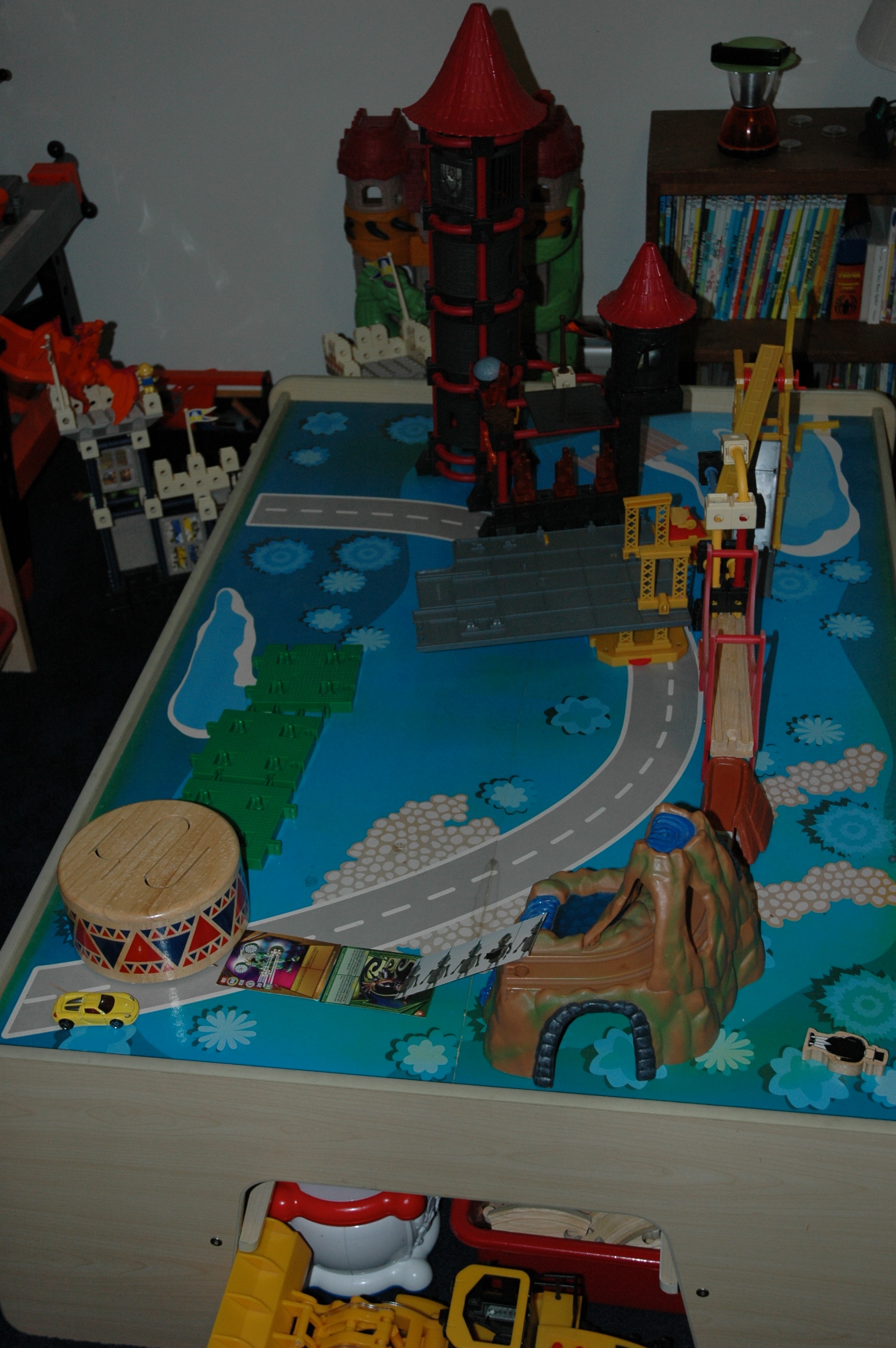
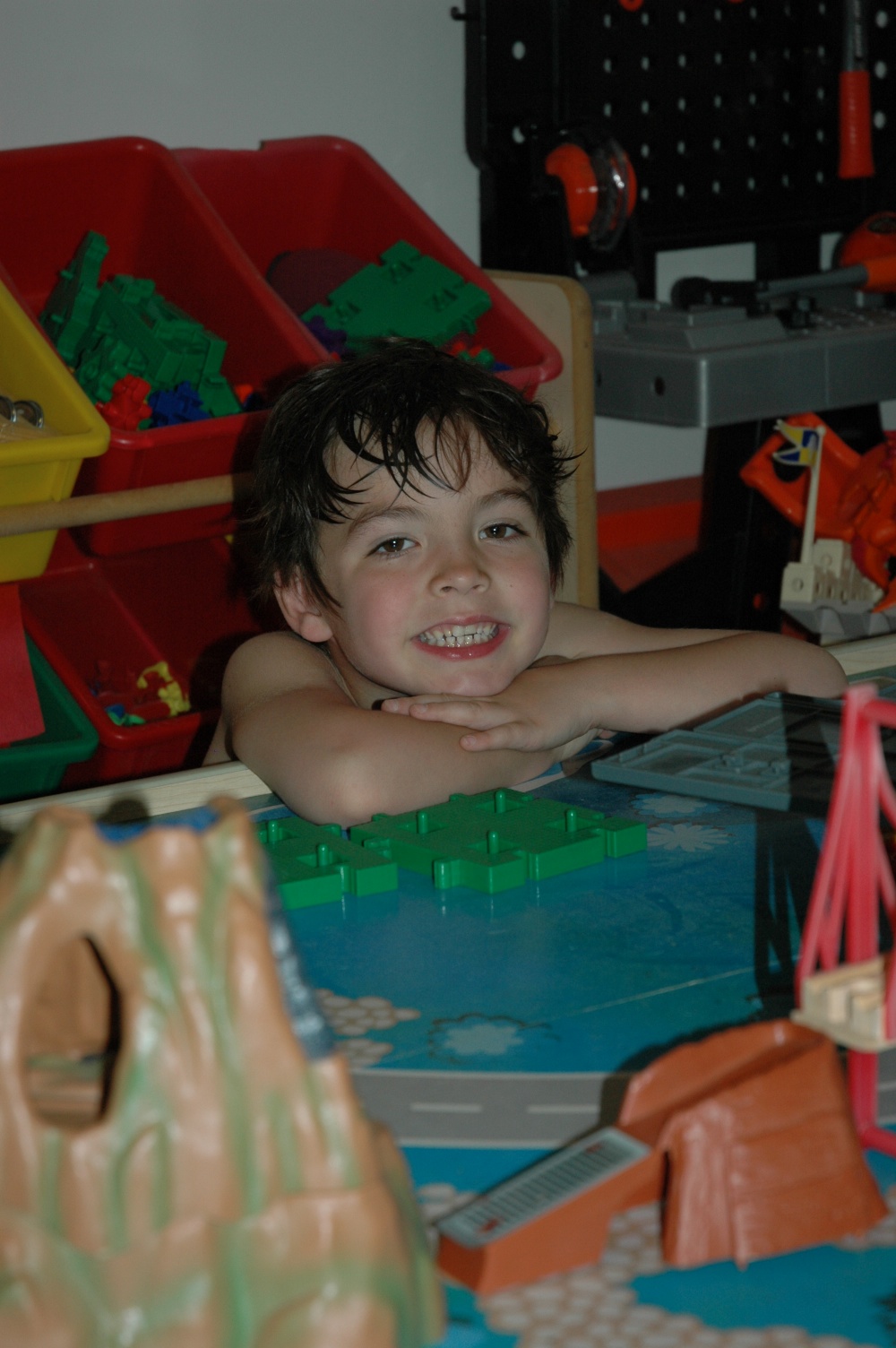
I tend to be on the neat (read OCD) side and I will, many times, ask my son to clean up one set of toys before starting a new one.  I have seen, in the past, that he will often mix up blocks or other toys of one type with another so I have tried to be more flexible about it.  Recently, he made a racetrack of all kinds of different materials, including train tracks, musical instruments, and Bakugon cards.  It’s interesting to me how, we as adults, don’t think naturally of mixing things up like this.  However, for a 4 year old, there is no apparent barrier to mixing things up.


Posted in Child Development, Teaching | Leave a comment

Mixing Blocks

I tend to be on the neat (read OCD) side and I will, many times, ask my son to clean up one set of toys before starting a new one.  I have seen, in the past, that he will often mix up blocks or other toys of one type with another so I have tried to be more flexible about it.  Recently, he made a racetrack of all kinds of different materials, including train tracks, musical instruments, and Bakugon cards.  It’s interesting to me how, we as adults, don’t think naturally of mixing things up like this.  However, for a 4 year old, there is no apparent barrier to mixing things up.

Posted in Aidan, Kids, Tech | Leave a comment

Take Aways From Tufts Conference

Here are some sketchy “take away” ideas from the Tufts conference.

Having a clear problem definition is key in determining direction of lessons and how much “thrashing” students do at the beginning of the engineering project.

How do we to change our instinctual reactions to be more in line with our underlying, often implicit goals in busy, goal oriented, multidimensional teaching environment?  How can we really take the time to understand student’s thinking?

Be clear on your objectives.  Robotics are very rich in terms of content and process.  You have science, engineering design, process, affective, and social goals.  If you are clear on where you want to go, your lessons have a greater chance of going there.  You can also deliberately choose to keep things open and go in the direction of the student’s interests and needs.

How to best mix concept and process goals?  There is a view that students should learn the process of science and engineering more than specific content at young age.  On the other hand, public school teachers must attend to our content standards.  How can be meet both objectives?

How can we make engineering documentation/products/drawings for young students more meaningful?  Need an authentic audience and/or sufficient complexity.

What makes for effective engineering instruction with young students?  A big question.  I am hoping to come up with a tips document specific to young students and also try and research this question more thoroughly through my own work and/or the work of others.

State and national standards are moving towards embedding engineering into standard and are also working them into younger grades.

How can we study the affective aspects of young boys with attention and learning issues that shine with Lego but not other areas of school?  Use more video in my PK-6 project to interview students.

Ideas for new talks.  Why Teach Engineering to Young Kids?  Top 10 Tips for Teaching Engineering to Young Kids

Lots of interest in the PK-6 Elementary Engineering Curriculum I am working on.  May set up a mailing list for early elementary engineering.


Posted in Child Development, Robotics, Teaching | Leave a comment