Recent Robot Magic

We had some great experiences with the grade 1 and 2 students this week.

When I asked our grade 2 students to recall what they knew about some parts this week for their first robotics class of the year, we were amazed by how much they recalled from first grade.  One student, who often struggles in school in some ways, gave the most amazing and accurate explanation of gears and teeth.  You could tell that he really got it and retained it from last year.  He was so excited to share his knowledge too!

We did some of the Lego WeDo Getting Started activities with two grade 1 classes this year.  The students were so enthusiastic!  They loved using laptops, building some simple motorized gears and pulleys in a circle together.   We explored basic concepts of gears, motors, pulleys, and programming.  This really seems to pay off when students build the robots from the activity pack such as Dancing Birds, which we will do next in first grade.

Some of the boys, in particular, were absolutely beaming when they got their first robots to work.  It was very rewarding.  We happened to have a reporter and photographer from the Daily Hampshire Gazette this week for an upcoming photo essay.  So I hope they will be able to capture, in words and photos, the magic of this activity.  They also visited grade 5 this week.


Posted in Child Development, Robotics, Teaching, Technology | Leave a comment

Latest Article on Setting Tech Limits With Kids

http://hilltownfamilies.wordpress.com/2012/01/16/heffernan-3/

Posted in Kids, Tech | Leave a comment

Research Protocols

I have been thinking of the yearly research tasks I want to do. Would appreciate any feedback since I know very little about standard educational research.

Elementary Engineering Robotics Case Study
Yearly Research Tasks
John Heffernan, Hampshire Regional Schools

Research Question #1
What are the developmental milestones in young children’s engineering skills?
Research Protocol

Students will be taken out of class and asked to build an interesting bridge using the given materials. The observer may ask the student to describe what they are doing but will not help or direct the student. Students will be filmed by a camcorder placed in an unobtrusive location.

Available Materials
• Wooden blocks
• Lego WeDo Robotics kit
• Lego NXT Mindstorms Robotics Kit
• Laptop
• Supply of large white paper (11×14) and sticky notes
• Markers, crayons, pencils, pens
• Scissors

Timing

Case study students (3 boys and 3 girls) will be asked to do this task every year in the spring from grades K to 6. It will take place after their yearly classroom robotics unit(s). Students will have up to 1 hour to build their bridge. Picture will be taken of final product. Student notes, if any, will be scanned. All artifacts, photos, and videos will be marked by student name/code and date.

Interview Questions (may be modified as needed for student and age)

1. Describe your bridge, how it works, the parts, etc.
2. What problems did you solve to make your bridge?
3. How do you feel about your bridge now? When you were making it?
4. Did you plan the bridge on paper or in your head before you made it? Did your plans change as you built the bridge?

Research Question #2
How will the deliberate and systemic teaching of engineering at a young age affect subsequent interest in engineering?
Research Protocol

We will survey grade six students with and without the Elementary Engineering Curriculum and look at years of elementary engineering experience (including none) with a willingness to consider engineering as a career. We will give the survey before and after the sixth grade robotics unit. Students will be taught what engineering is before the survey is taken. Here is a copy of the survey. Note that the use of the word “consider” is in line with the recent Intel study of student interest in engineering. [Survey of Teens’ Perceptions of Engineering, December 6, 2011]

Grade 6 Robots – Post Survey

NAME __________________________ DATE __________________________________

What is a robot?

What is engineering?

How much do you agree or disagree with these statements? Circle One.

I would consider becoming an engineer when I am older.

Strongly Agree Agree Neither Agree or Disagree Disagree Strongly Disagree

I like using computers and other technology.

Strongly Agree Agree Neither Agree or Disagree Disagree Strongly Disagree

Research Question #3

How do elementary schools promote or inhibit the natural engineering instincts of children?

Research Protocol

We will create a survey of materials and activities present in elementary (PK-6) classrooms that promote engineering and compare the results by grade level. Materials to be listed in the survey with option for “other” are shown below. (This list will be expanded.)

• Blocks
• Sand table
• Water table
• Legos
• Lego robotics
• BeeBots
• PicoCricket robotics
• Bridge building
• Marble runs – commercial
• Marble runs – student made
• Electrical circuits
• Simple machine kits
• Make musical instruments

There will an option for each one item for After School, Recess/Choice, and Curriculum Integrated.

We will also do videotaped interviews of students each year after robotics units have been completed and ask all or some of the following questions.

1) What did you like about project(s) you did this year? How could we change robotics so they could be even better?
2) Make on observation about their experience this year and ask them to comment on it .
3) What was it like to do robotics? How is it different from other schoolwork?
4) What was frustrating or challenging?
5) What do you think you learned from the project?
6) Do you have any advice for next year’s students that will do this project?
7) Anything else we have not talked about?

The answer will be coded and analyzed for similarities. Interesting quotes will be transcribed.
Posted in Child Development, Research, Robotics, Teaching, Technology | Leave a comment

Sample Burglar Alarm Pitch

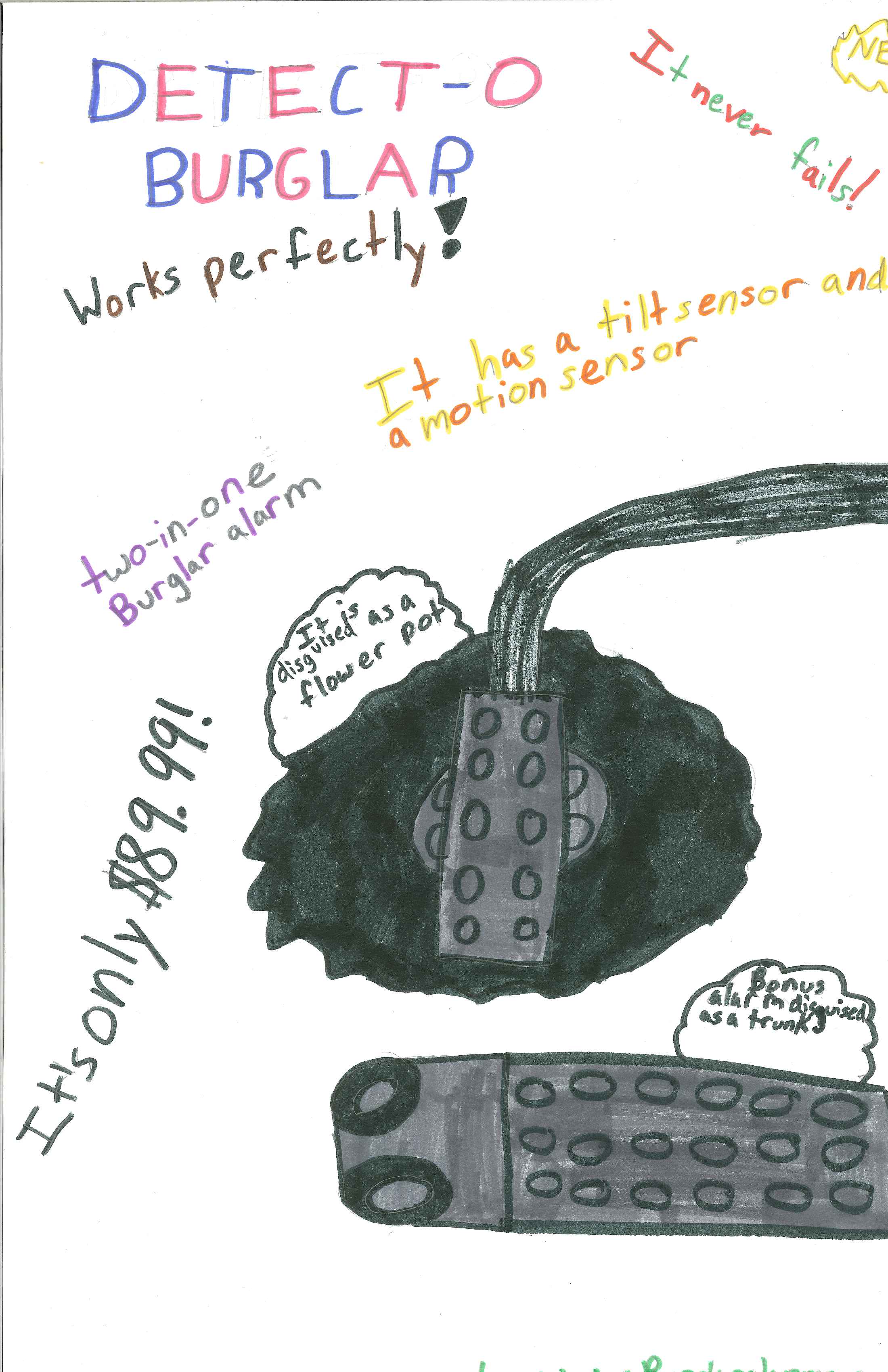
Here’s one of our top salespeople, MC, pitching her team’s burglar alarm. Students designed, built, tested, refined, and made a poster for a WeDo based burglar alarm. This is an open ended engineering challenge. That means the students design the project on their own. We added the WeDo Resource Kits this year, which provides additional parts. This really added a lot to the project.

Posted in Robotics, Teaching, Technology | Leave a comment

Yearly Case Study Task

Would love some feedback on this…

Case Study Yearly Task

Research Questions
1. What are the developmental milestones in young children’s engineering skills?
2. How will the deliberate teaching of engineering at a young age affect subsequent interest in engineering?
3. How do schools promote or inhibit the natural engineering instincts of children?

Task

Students will be taken out of class and asked to build an interesting bridge using the given materials. The observer may ask the student to describe what they are doing but will not help or direct the student. Students will be filmed by a camcorder placed in an unobtrusive location.

Available Materials
• Wooden blocks
• Lego WeDo Robotics kit
• Lego NXT Mindstorms Robotics Kit
• Laptop
• Supply of large white paper (11×14) and sticky notes
• Markers, crayons, pencils, pens
• Scissors

Timing

Case study students (3 boys and 3 girls) will be asked to do this task every year in the spring from grades K to 6. It will take place after their yearly classroom robotics unit(s). Students will have up to 1 hour to build their bridge. Picture will be taken of final product. Student notes, if any, will be scanned. All artifacts, photos, and videos will be marked by student name/code and date.

Interview Questions (may be modified as needed for student and age)

1. Describe your bridge, how it works, the parts, etc.
2. What problems did you solve to make your bridge?
3. How do you feel about your bridge now? When you were making it?
4. Did you plan the bridge on paper or in your head before you made it? Did your plans change as you built the bridge?

Posted in Child Development, Research, Robotics, Technology | 2 Comments

Grade 4 Burglar Alarm Poster

Students need to create poster to sell the burglar alarms they created in their Lego WeDo based open ended challenge. Here’s one example.

Posted in Robotics, Teaching | Leave a comment

Scalability of Lego Engineering for Elementary and Middle Schools

I’ve been wondering how scalable either my ELementary Engineering Curriculum or any other similar program would be in terms of cost per student. So if we assume 24 kids per class, kids working in pairs, teachers sharing the kits by quarters, schools with 1, 2, 3, or 4 classes per grade, and BeeBot at K, Lego WeDo at grades 1 to 4, and Lego NXT at grades 5 and 6, we get the following results.

1 Class Per Grade $37/student $6232
2 Classes Per Grade $23/student $7672
3 Classes Per Grade $25/student $12,664
4 Classes Per Grade $21/student $13,804

Some configurations result in a better cost efficiencies since the kits are more fully utilized. This only includes the cost of the robotics and does not include professional development or associated laptops.

[Note: I revised these figures on 12/21/2011 to more accurately reflect WeDo site license pricing.]

Posted in Robotics, Teaching, Technology | 3 Comments

Adventure Story

Airplane Adventure
by
Katie and Becca


Hi.  My name is Serena.  I wanted to go to France.  I got in my plane and started it up.

[Narrator] When she got into the sky, a flock of birds flew in her way.  She quickly dodged them.  Then she heard a bump, bump, bump.  It was her plane.

All of a sudden, she was on the ground.  She started to look for fuel.  Then she found some so she got some fuel put in her plane and started it up.  She was in the sky.

Then a big thunderstorm came.  There were buckets of rain and lots of lightning.  A big lightning bolt struck her plane band she fell to the ground and there she was, in France!  She was fine.  I wonder what will happen in her next flight.

Posted in Robotics, Teaching, Technology | 1 Comment

Sample Third Grade Amazing Adventure Story

Third graders wrote and acted out (with their robots) adventure stories.  Here’s a sample story.  I’ll post a video next of a different team.

The Adventure of Max Toney by CW and AB

Max Toney is ready for the summer.
He’s 20. He wants to ride an airplane. He calls his parents and asks, “Am I allowed to ride an airplane?”
“Yes, of course!”
Then he said, ”Thanks, bye!”
“We love you!”
“Mom, dad, I’m not a baby. You embarrass me!” says Max.
“All right, well, say bye!”
“Thanks, bye!” Max hung up. He took his airplane in his back yard. He already had an airplane from college and took lessons to learn to fly it. He gets in the airplane and rides it. There are 20 airplanes in the air! He hits one, falls, and……. BOOM! goes the airplane! Then he  hits the parachute button and the parachute and the airplane go down slowly in the air. Max lands in the back of his parents’ yard! His parents come running out of the house and say, “ARE YOU OKAY?!”
“Yes, there’s a parachute!” They felt proud of him because he was prepared and he was proud of himself for every reason! His parents were so happy! He felt fine!
The End

Posted in Robotics, Teaching, Technology | 2 Comments

Cool Burglar Alarm

Burglar Alarm Example

Fourth grade burglar alarm that uses 2 sensors


Here was one cool burglar alarm from today.  There is a motion sensor to detect motion at the door.  The kids were challenged to use the tilt sensor too.  This team put some cams in front of the door.  They are connected via an axle and an elaborate structure to a tilt sensor outside the house.  Another team successfully made the motor close the door when a burglar is detected.  Not easy!  Having the Resource Kits available this year made huge difference in what the kids came up with.

Posted in Robotics, Teaching, Technology | Leave a comment