Design Based Science Bibliography

Barak, M., & Zadok, Y. (2009). Robotics projects and learning concepts in science, technology and problem solving. International Journal of Technology and Design Education, 19(3), 289–307.
Baynes, K. (1994). Designerly play. Loughborough: Loughborough University of Technology, Department of Design and Technology.
Brophy, S., Portsmore, M., Klein, S., & Rogers, C. (2008). Advancing Engineering Education in P-12 Classrooms. Journal of Engineering Education, 97(3).
Confrey, J. (1990). A Review of the Research on Student Conceptions in Mathematics, Science, and Programming. Review of Research in Education, 16, 3–56.
Crismond, D. (2001). Learning and using science ideas when doing investigate-and-redesign tasks: A study of naive, novice, and expert designers doing constrained and scaffolded design work. Journal of Research in Science Teaching, 38(7), 791–820.
Fleer, M. (1999). The science of technology: Young children working technologically. International Journal of Technology and Design Education, 9(3), 269–291.
Fortus, D., Krajcik, J., Dershimer, R. C., Marx, R. W., & Mamlok-Naaman, R. (2005). Design‐based science and real‐world problem‐solving. International Journal of Science Education, 27(7), 855–879. doi:10.1080/09500690500038165
Hmelo, C. E., Holden, D. A., & Kolodner, J. L. (2000). Designing to Learn about Complex Systems. The Journal of the Learning Sciences,, 9(3), 247–298.
Hynes, M., Crismond, D., & Brizuela, B. (2010). AC 2010-447: MIDDLE-SCHOOL TEACHERS’ USE AND DEVELOPMENT OF ENGINEERING SUBJECT MATTER KNOWLEDGE. American Society for Engineering Education.
Kendall, M. A. L. M., & Wendell, K. (2012). AC 2012-4068: UNDERSTANDING THE BELIEFS AND PERCEPTIONS OF TEACHERS WHO CHOOSE TO IMPLEMENT ENGINEERING-BASED SCIENCE INSTRUCTION. Presented at the ASEE Annual Conference, San Antonio, TX: American Society for Engineering Education. Retrieved from http://www.asee.org/file_server/papers/attachment/file/0002/3140/ASEE_Paper_Final_Draft.pdf
Kolodner, J. L., Camp, P. J., Crismond, D., Fasse, B., Gray, J., & Holbrook, J. (2003). Problem-based learning meets case-based reasoning in the middle-school science classroom: Putting Learning by Design (TM) into practice. Journal of the Learning Sciences, 12(4), 495–547.
Leonard, M. J., & Derry, S. J. (2011). “What’s the Science Behind It?” The Interaction of Engineering and Science Goals, Knowledge, and Practices in a Design-Based Science Activity. Retrieved from http://widaredesign.wceruw.org/publications/workingPapers/Working_Paper_No_2011_05.pdf
McRobbie, C. J., Stein, S. J., & Ginns, I. (2001). Exploring designerly thinking of students as novice designers. Research in Science Education, 31(1), 91–116.
Mehalik, M. M., Doplet, Y., & Schunn, C. D. (2008). Middle-school science through design-based learning versus scripted inquiry: Better overall science concept learning and equity gap reduction. Journal of Engineering Education, 97(1), 75=81.
Narode, R. B. (2011). “‘Math in a Can’”: Teaching Mathematics and Engineering Design. Journal of Pre-College Engineering Education Research (J-PEER), 1(2), 3.
Nourbakhsh, I. R., Hamner, E., Crowley, K., & Wilkinson, K. (2004). Formal measures of learning in a secondary school mobile robotics course. In Robotics and Automation, 2004. Proceedings. ICRA’04. 2004 IEEE International Conference on (Vol. 2, pp. 1831–1836). Retrieved from http://ieeexplore.ieee.org/xpls/abs_all.jsp?arnumber=1308090
Nugent, G., Barker, B. S., Grandgenett, N., & Adamchuk, V. I. (2010). Impact of robotics and geospatial technology interventions on youth STEM learning and attitudes. Retrieved from http://digitalcommons.unomaha.edu/tedfacpub/33/?utm_source=digitalcommons.unomaha.edu%2Ftedfacpub%2F33&utm_medium=PDF&utm_campaign=PDFCoverPages
Outterside, Y. (1993). The emergence of design ability: The early years. Retrieved from https://dspace.lboro.ac.uk/dspace/handle/2134/1574
Perova, N., Johnson, W. H., & Rogers, C. (2008). USING LEGO BASED ENGINEERING ACTIVITIES TO IMPROVE UNDERSTANDING CONCEPTS OF SPEED, VELOCITY, AND ACCELERATION. American Society for Engineering Education.
Puntambekar, S., & Kolodner, J. L. (2005). Distributed Scaffolding: Helping Students Learn Science from Design. Journal of Research in Science Teaching`, 42(2), 185–217.
Roth, W.-M. (1996). Art and Artifact of Children’s Designing: A Situated Cognition Perspective. Journal of the Learning Sciences Journal of the Learning Sciences, 5(2), 129–166.
Schunn, C. D. (2009). How Kids Learn Engineering:  The Cognitive Science Perspective. National Academy of Engineering, The Bridge, 39(3). Retrieved from http://www.nae.edu/Publications/Bridge/16145/16214.aspx?layoutChange=Normal&PS=10&PI=0&TC=8&BBM=0
Sullivan, F. R. (2008). Robotics and science literacy: Thinking skills, science process skills and systems understanding. Journal of Research in Science Teaching, 45(3), 373–394. doi:10.1002/tea.20238
Wagner, S. P. (1999). Robotics and Children Science Achievement and Problem Solving. Journal of Computing in Childhood Education, 9(2), 149–192.
Welch, M. (1999). Analyzing the Tacit Strategies of Novice Designers. Research in Science & Technological Education, 17(1), 19–33.
Wendell, K. B. (2011). Science through Engineering in Elementary School: Comparing Three Enactments of an Engineering-Design-Based Curriculum on the Science of Sound. ProQuest LLC. Retrieved from http://www.eric.ed.gov/ERICWebPortal/recordDetail?accno=ED528030
Wendell, K. B., & Lee, H. S. (2010). Elementary students’ learning of materials science practices through instruction based on engineering design tasks. Journal of Science Education and Technology, 19(6), 580–601.
Wendell, K., Connolly, K., Wright, C., Jarvin, L., Rogers, C., Barnett, M., & Marculu, I. (2010). AC 2010-863: POSTER, INCORPORATING ENGINEERING DESIGN INTO ELEMENTARY SCHOOL SCIENCE CURRICULA.pdf. Presented at the International Conference of the Learning Sciences, Chicago, IL: American Society for Engineering Education.
Wendell, M. K. B., & Portsmore, M. D. (2011). AC 2011-904: THE IMPACT OF ENGINEERING-BASED SCIENCE IN-STRUCTION ON SCIENCE CONTENT UNDERSTANDING. Presented at the Annual International Conference of the National Association for Research in Science Teaching (NARST), Orlando, FL. Retrieved from http://www.asee.org/file_server/papers/attachment/file/0001/1144/Draft_ASEE2011_Wendell_version2.pdf
Williams, D., Ma, Y., Lai, G., Prejean, L., & Ford, M. J. (2007). Acquisition of Physics Content Knowledge and Scientific Inquiry Skills in a Robotics Summer Camp. In Society for Information Technology & Teacher Education International Conference (Vol. 2007, pp. 3437–3444). Retrieved from http://www.editlib.org/p/25146/
Posted in Research, Robotics | Leave a comment

Grade 3 Vehicle Challenge

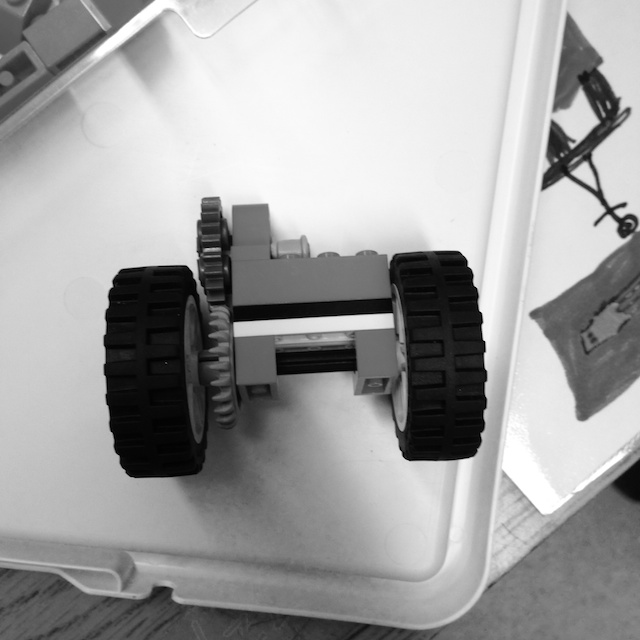
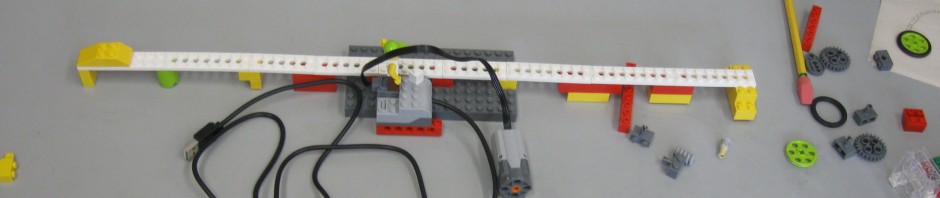
Here are some photos from our grade 3 open ended challenge to design a WeDo vehicle.  I reviewed 3 ways to connect motor to wheels before they started: gears, pulleys, or direct drives. Students used the base WeDo kit. However, I added additional long axles and tires/wheel from the WeDo Resource kit.

Grade3 Vehicles 1

Students were trying first to make a stable chassis out of rubber bands.
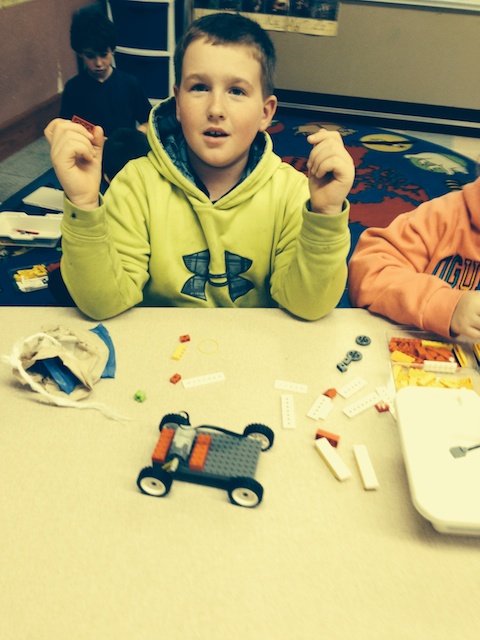
Gifted Builder

This student and his partner quickly came up with a functional car design. He does many building projects at home with his father. He quickly built a chassis and drive train.

Grade3 Vehicles 3

Notice the double belt

Grade3 Vehicles 4

These students built the drive train (out of gears first) before building the chassis.
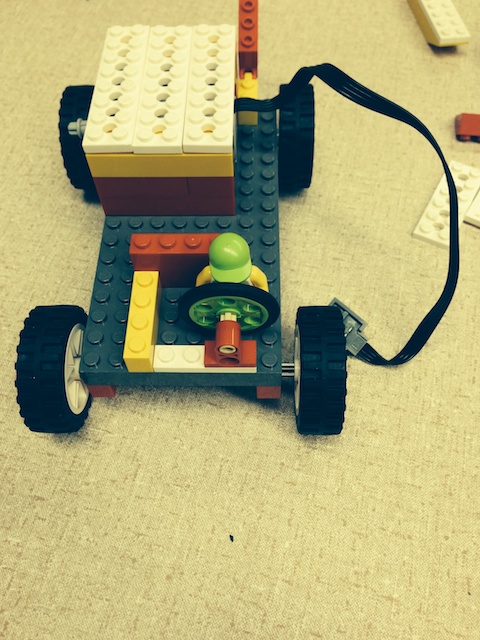
Grade3 Vehicles 5

This was the final car from the student who is a gifted builder. They hid the engine under some LEGO plates and added a realistic steering wheel.

Grade3 Vehicles 6

These students decided the more belts, the better. However, I believe they will be in opposition to each other and one will have to be removed.

Grade3 Vehicles 7

Here’s another gear design. Usually, belts designs are easier than gear designs. However, 2 teams came up with good gear designs.


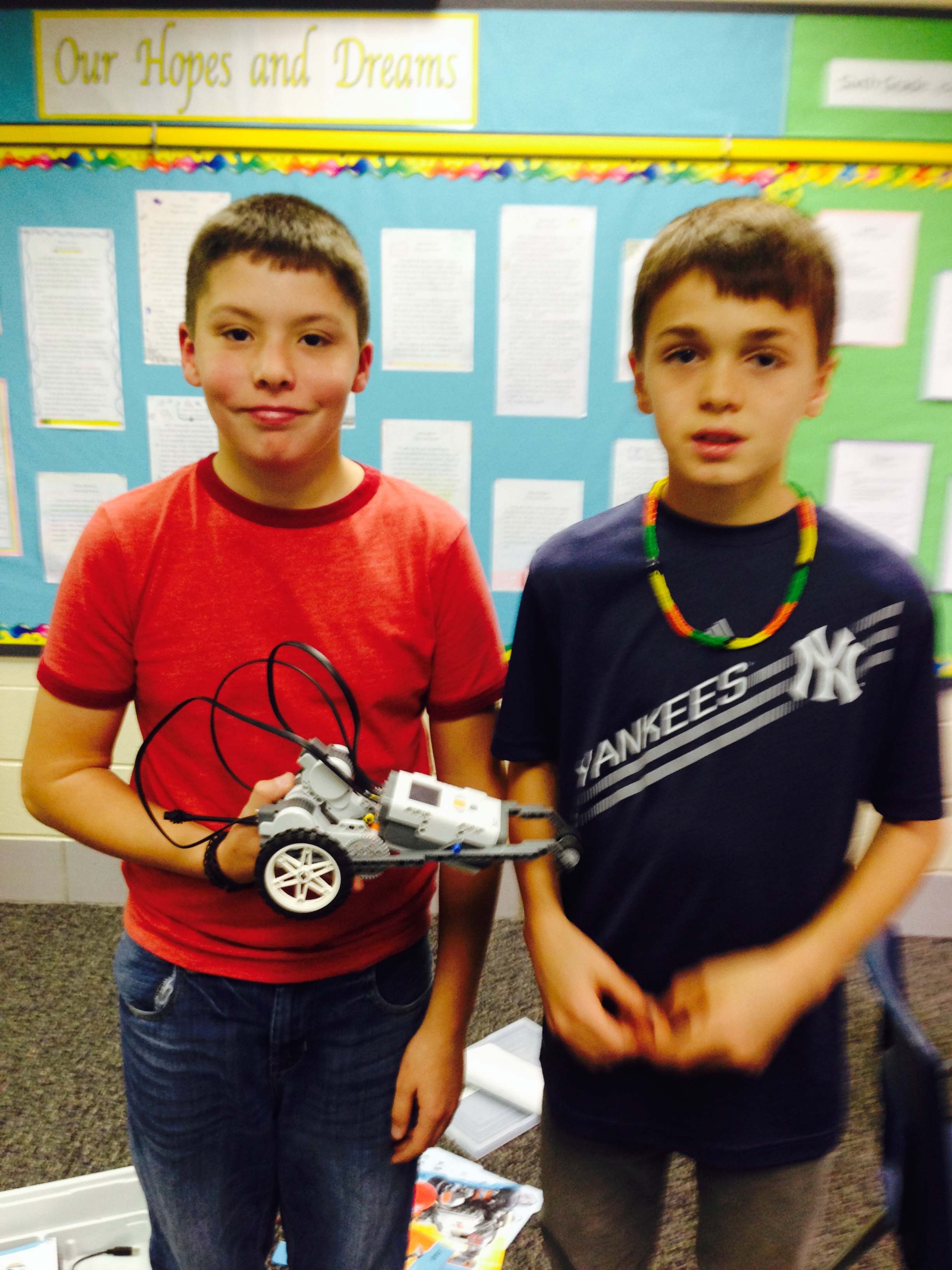
One girl did some design drawings, which is unusual without it being required.  I suggested it but did not require it.
 

DrawingRotated

Posted in Child Development, Research, Robotics, Teaching | 5 Comments

Design Based Science

A few of you may be interested in this literature review of design based science I just completed.  It reviews a good number of papers and studies that evaluate how science concepts and processes can be taught using design.  Design includes engineering and robotics.  Here’s the abstract.

Although robotics has been identified as a promising way to increase STEM interest and also teach science concepts (Brophy, Portsmore, Klein, & Rogers, 2008), there is no research of student use of robotics in a sustained elementary program.  The studies that do exist show promising results for short term robotics programs in middle and high school (Hynes, 2007; Sullivan, 2008).  There are many studies that use design, engineering, or robotics as a way to teach science concepts. This literature review examines relevant papers on using design to teach science and engineering concepts.  The goal of the review is to determine the most relevant theoretical frameworks and methodologies that can be used or modified in a longitudinal case study of elementary robotics students.  A model for classifying the studies is presented.  The studies uniformly use a constructivist, constructionist, and social constructivist approach.  The studies vary in the age group studied, study methodologies, and the secondary goals of the instruction apart from the science focus. The studies report positive results but differ in their recommendations for instruction strategies.  However, common themes are providing appropriate scaffolding to connect the design tasks to specific science concepts and processes.

Because the orientation changed, it was inexplicably split into 3 pieces when I created the PDF from Word.

DesignBasedScienceLitReview

DesignBasedScienceLitReview.2

DesignBasedScienceLitReview.3

Posted in Child Development, Research, Robotics | Leave a comment

Book Now Available!

https://www.createspace.com/4488315

Toddlers, preschoolers, and kindergarteners are natural engineers. They love sand castles, blocks, fairy houses, and other projects that support their creative, fantasy play. We support this natural engineering instinct in preschool and kindergarten classrooms with blocks, LEGOs, sand and water tables, and other activities. As students reach first grade and beyond, we remove all these activities from school. Yet we still expect them be interested in engineering when they get to high school and college.

The Elementary Engineering Curriculum (EEC), described in this book, supports students’ natural engineering interests all through elementary school. The EEC delivers a preschool to grade six engineering experience based on BeeBot, and LEGO WeDo, NXT, and EV3 robotics. Each year, students have at least one robotics unit. In grades K, two, three, four, six, students also have an open ended engineering challenge. The EEC explicitly teaches the engineering design process in an age appropriate way. Robotics provides very high interest, motivating, and deep learning experience for students. This book contains rationale, descriptions, research, and teaching tips on elementary robotics as well as complete lesson plans and standards alignment for the curriculum.

Posted in Robotics, Teaching | 1 Comment

Dragster Record Broken

Two great designers and great grade 6 kids, Kyle and Mark, worked together in an exceptional way to break my current record for dragster cars.  They achieved 7.7 ft/sec beating the old record of 7.63 ft/sec.  They created a dozen or so different designs in our once a week, 8 week unit.

KyleMarkDragster

Posted in Robotics | Leave a comment

Book Nearing Completion

I am in the (hopefully) final throes of producing my book Elementary Engineering:  Sustaining the Natural Engineering Instincts of Children.  I decided to self publish through createspace.com.  Going through large companies was taking to long.  I hope to have it available within a month.  It sure has been a ton of work!  But I think it will be a valuable book for PK-6 robotics teachers.

Posted in Robotics | Leave a comment

Designing Ahead

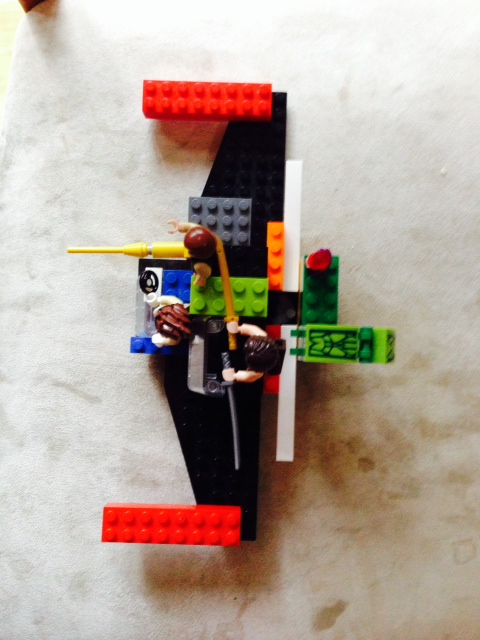
How much young students can plan ahead is a hot topic in educational research (well, at least to me).  In discussing our recent designs, my son Aidan (age 7) volunteered that that he thinks about a design ahead of time and then tries to build it.  I also noticed today that he seems much more interested in symmetry in his designs.  I would like to research various design properties such a symmetry and see how they develop over time.  Fighter Jet/Spaceship

Posted in Child Development, Research | Leave a comment

4 Color Problem Case Study Results

I recently completed a exploratory research project that examined how learners respond to a difficult but motivating math problem.   I did a small case study, which compared adult math experts, advanced math students (one grade 1 and two grade 4), and two normal grade 4 math students.  The problem is a famous problem from discrete mathematics and computer science called the map coloring problem:  what is the least amount of colors needed to color in any arbitrary map such that no two neighbors (who share a side) have the same color?  Neighbors that only share a point can have the same color.

I found that there were not significant differences in strategies between learners.  The adult learners were more able to articulate their strategies.  On the other hand, young students were much more motivated to work on the problem when they were told that no one had ever found a five color map before.  (A five-color map would require 5 colors.)

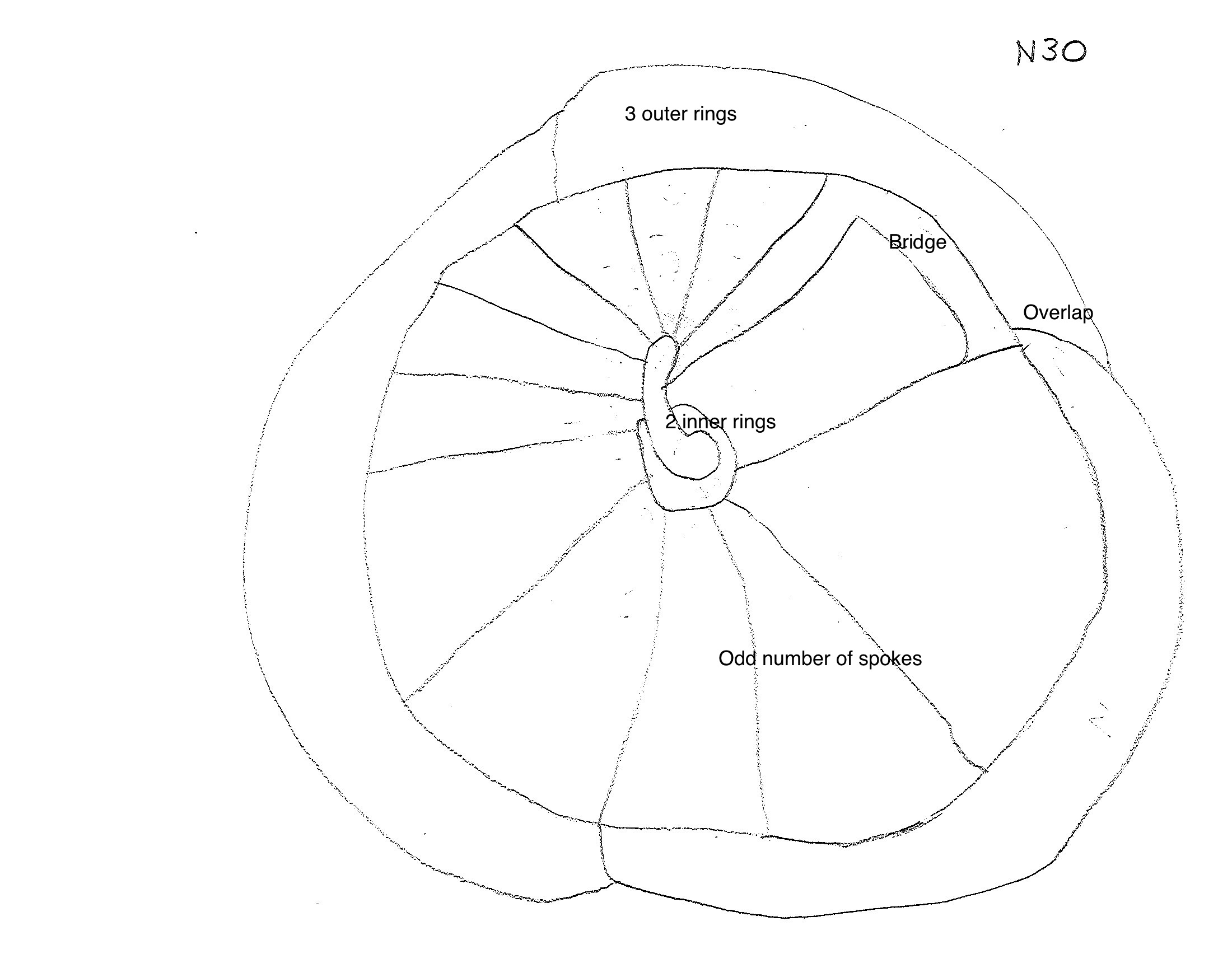
I examined the five color map attempts of one of the student experts in detail.  This student, without prompting, produced over thirty attempted 5 color maps over several months.  When I looked at the progression of this map attempts, I found an interested combination of strategies.  He combined old strategies with new strategies in different combinations in his attempts.  See if you can color the example below with only 4 colors.  Further research is needed to:  investigate differences between students in this process, further analyze and classify the progression of ideas and knowledge, and determine the factors that make this problem so motivating.  One thing is clear:  the adaptation of rich mathematical problems is a highly motivating way to promote deep mathematical thinking and conceptual understanding with elementary students.

For more information, see:

https://kidsengineer.com/?p=620 Video of students working the problem

https://kidsengineer.com/?p=612 Study conclusions

http://csunplugged.org/ Web site with other rich computer science lessons for kids

5 Color Map Attempt #30 - Garde 1 Math Expert

5 Color Map Attempt #30 – Grade 1 Math Expert With Some Strategies Labelled


Posted in Child Development, Research, Teaching | Leave a comment

Calculating Velocity

I had a great team of 2 boys this week who were the first to build a LEGO NXT Dragster.  I usually instruct kids to build a 10 foot course and time the car.  Well, I noticed they were setting up a measuring course their own way so I was curious to see what they would do without specific directions.

I watched trying to determine the velocity of their car and was initially confused because the were not using a stop watch but a timer.  So they measured the distance (in feet) the car went in 1 second rather than the time to go 10 feet.  In the latter case, the velocity is 10/t.  The way the boys measured, it is much easier to calculate.  The velocity is simply the distance because it is over 1 second.  I thought that showed a really good understanding of velocity and possibly ratio.  Also, it showed what teachers can learn when the give kids more space to come up with their own solutions.

By the way, their car went 4 ft/sec using 2 gears and they immediately set out to improve the speed using 3 gears.


Posted in Robotics, Teaching | Leave a comment

Year 2 Case Study Results – Summary

Year 2 – Longitudinal Robotics Case Study

John Heffernan – 7/7/13

Introduction

This basic research seeks to understand how children’s engineering skills change over time. Secondarily, I want to know how our K-6 robotics program influences students.  Every year from kindergarten to grade 6, they are given the same task, which is to design and built a prototype (model) amusement park ride.  Each year, they are offered crafts materials and an age appropriate LEGO ™ kit.  I transcribe their verbal output and take photographs of their creations along with selected video clips.

Major Findings – Year 2

All students primarily used LEGO ™ this year; there were no all craft constructions.  In kindergarten, there were 2 all craft constructions.

2 out of 9 students used the computer and motor even though all had learned it in class.  Both were advanced students.  This suggests that most students were not comfortable with using the computer to program robots yet or it was not a natural technique for them developmentally.

Even one advanced student frequently used tape to augment construction.    Construction techniques were major challenge this year.   I am seeing certain construction problems across grade levels that would benefit from some scaffolding.  Fine motor skills, which were a major challenge for K students, was less of an issue for first graders.

First graders were not concerned with many adult notions like symmetry and consistency though they may notice and comment on them.  They often were not able to project out that different design ideas  that would not be stable or buildable.

Inherent building styles and personalities seem fairly well set and on a trajectory of some sort.  I was surprised by this because I thought developmental gains and what was taught would be much more dominant.  However, the use of LEGO ™ at school may have influenced the choice of materials and had some effect on construction.

Self-talk was much less prominent for grade 1 students than K students.

Some students made up the ride as they went along, others had a clear idea and stuck to it, other had ideas but flexibly changed them as they went along.

As you can see from the photos of year 1 and year 2 projects, there was a big jump in sophistication from spring K to spring grade 1.

Click here for the Case Study Year 2 Report with photos.


Posted in Child Development, Research, Robotics | Leave a comment