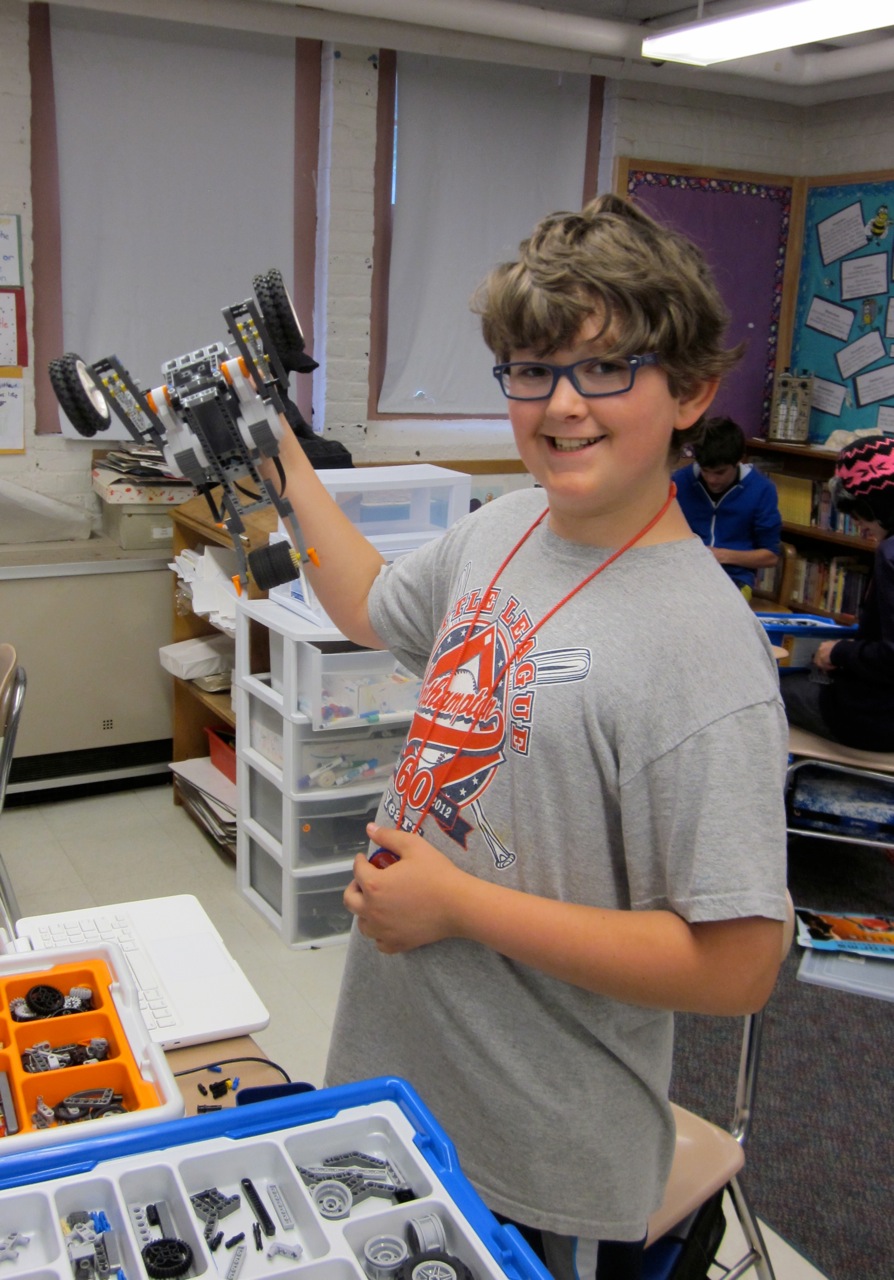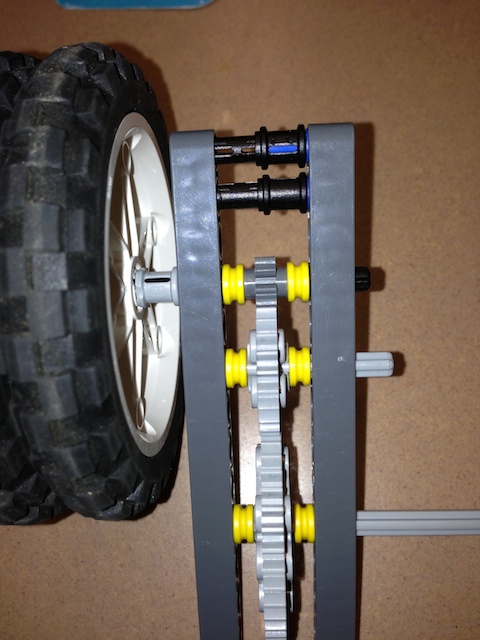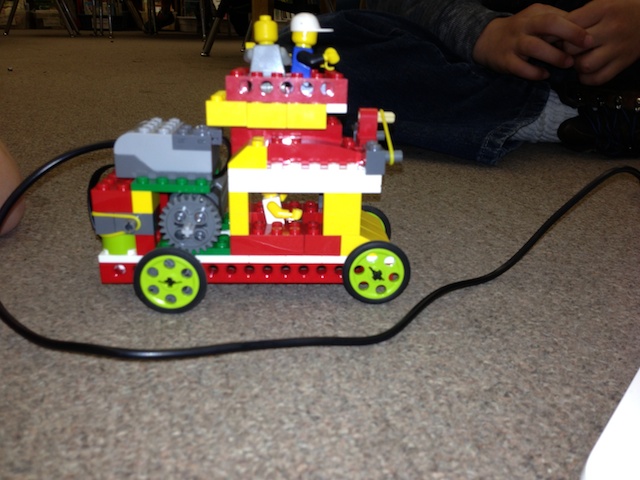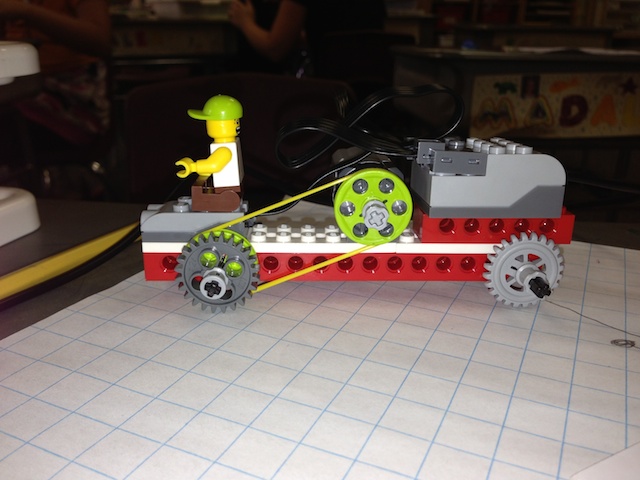
As part of my book project and for graduate school, I am working on a research chapter for my elementary robotics book. Next step is an annotated bibliography but here is the non-annotated one for now. I will post a nicely formatted PDF of this under Resources.
Alimisis, D. (n.d.). Robotics in Education & Education in Robotics: Shifting Focus from Technology to Pedagogy. Retrieved from http://www.etlab.eu/files/alimisis_RIE2012_paper.pdf
Barak, M., & Zadok, Y. (2009). Robotics projects and learning concepts in science, technology and problem solving. International Journal of Technology and Design Education, 19(3), 289–307.
Barker, B. S., & Ansorge, J. (2007). Robotics as means to increase achievement scores in an informal learning environment. Journal of Research on Technology in Education, 39(3), 229.
Barker, Bradley S., Nugent, G., Grandgenett, N., & Adamchuk, V. I. (2012). Robots in K-12 Education: A New Technology for Learning. IGI Global. Retrieved from http://services.igi-global.com/resolvedoi/resolve.aspx?doi=10.4018/978-1-4666-0182-6
Benitti, F. B. V. (2012). Exploring the educational potential of robotics in schools: A systematic review. Computers & Education, 58(3), 978–988. doi:10.1016/j.compedu.2011.10.006
Brophy, S., Portsmore, M., Klein, S., & Rogers, C. (2008). Advancing Engineering Education in P-12 Classrooms. Journal of Engineering Education, 97(3).
Cejka, E, Rogers, C., & Portsmore, M. (2006). Kindergarten Robotics: Using Robotics to Motivate Math, Science, and Engineering Literacy in Elementary School. International Journal of Engineering Education, 22(4), 711–722.
Cejka, Erin, & Rogers, C. (2005). Inservice Teachers and the Engineering Design Process. Proc. Amer. Soc. Eng. Ed. Retrieved from http://soe.rutgers.edu/files/Inservice%20Teachers%20and%20the%20Engineering%20Design%20Process.pdf
Computing Community Consortium. (2009, May 21). A Roadmap for US Robotics From Internet to Robotics. Computing Community Consortium. Retrieved from http://www.us-robotics.us/reports/CCC%20Report.pdf
Erwin, B., Cyr, M., & Rogers, C. (2000). LEGO engineer and ROBOLAB: Teaching engineering with LabVIEW from kindergarten to graduate school. International Journal of Engineering Education, 16(3), 181–192.
Hussain, S., Lindh, J., & Shukur, G. (2006). The Effect of LEGO Training on Pupils’ School Performance in Mathematics, Problem Solving Ability and Attitude: Swedish Data. Educational Technology & Society, 9(3), 182–194.
Hynes, M. (2007). AC 2007-1684: IMPACT OF TEACHING ENGINEERING CONCEPTS THROUGH CREATING LEGO-BASED ASSISTIVE DEVICES. Presented at the American Society for Engineering Education Annual Conference & Exposition, Honolulu,HI: American Society for Engineering Education. Retrieved from http://icee.usm.edu/ICEE/conferences/asee2007/papers/1684_IMPACT_OF_TEACHING_ENGINEERING_CONCEPTS_.pdf
Hynes, M., Crismond, D., & Brizuela, B. (2010). AC 2010-447: MIDDLE-SCHOOL TEACHERS’ USE AND DEVELOPMENT OF ENGINEERING SUBJECT MATTER KNOWLEDGE. American Society for Engineering Education.
Hynes, M. M., Crismond, D., & Danahy, E. (2010). AC 2010-457: USING ROBOBOOKS TO TEACH MIDDLE SCHOOL ENGINEERING AND ROBOTICS.pdf. Presented at the American Society for Engineering Education Annual Conference & Exposition, Louisville, KY: American Society for Engineering Education.
Kearns, S. A., Rogers, C., Barsosky, J., Portsmore, M., & Rogers, C. (2001). Successful methods for introducing engineering into the first grade classroom. In ASEE Annual Conference and Exposition Proceedings, Albuquerque, New Mexico.
Korchnoy, E., & Verner, I. M. (2008). Characteristics of learning computer-controlled mechanisms by teachers and students in a common laboratory environment. International Journal of Technology and Design Education, 20(2), 217–237. doi:10.1007/s10798-008-9071-7
Lindh, J., & Holgersson, T. (2007). Does lego training stimulate pupils’ ability to solve logical problems? Computers & Education, 49(4), 1097–1111. doi:10.1016/j.compedu.2005.12.008
Ma, Y., Lai, G., Prejean, L., Ford, M. J., & Williams, D. (2007). Acquisition of Physics Content Knowledge and Scientific Inquiry Skills in a Robotics Summer Camp. In Society for Information Technology & Teacher Education International Conference (Vol. 2007, pp. 3437–3444). Retrieved from http://www.editlib.org/p/25146/
Mitnik, R., Nussbaum, M., & Recabarren, M. (2009). Developing Cognition with Collaborative Robotic Activities. Educational Technology & Society, 12(4), 317–330.
Mitnik, Ruben, Nussbaum, M., & Soto, A. (2008). An autonomous educational mobile robot mediator. Autonomous Robots, 25(4), 367–382.
Nataliia Perova, Walter H. Johnson, & Chris Rogers. (2008). USING LEGO BASED ENGINEERING ACTIVITIES TO IMPROVE UNDERSTANDING CONCEPTS OF SPEED, VELOCITY, AND ACCELERATION. American Society for Engineering Education.
Nugent, G., Barker, B., Grandgenett, N., & Adamchuk, V. (2009). The use of digital manipulatives in K-12: robotics, gps/gis and programming. In Frontiers in Education Conference, 2009. FIE’09. 39th IEEE (pp. 1–6). Retrieved from http://ieeexplore.ieee.org/xpls/abs_all.jsp?arnumber=5350828
Nugent, G., Barker, B. S., Grandgenett, N., & Adamchuk, V. I. (2010). Impact of robotics and geospatial technology interventions on youth STEM learning and attitudes. Retrieved from http://digitalcommons.unomaha.edu/tedfacpub/33/?utm_source=digitalcommons.unomaha.edu%2Ftedfacpub%2F33&utm_medium=PDF&utm_campaign=PDFCoverPages
Owens, G., Granader, Y., Humphrey, A., & Baron-Cohen, S. (2008). LEGO ® Therapy and the Social Use of Language Programme: An Evaluation of Two Social Skills Interventions for Children with High Functioning Autism and Asperger Syndrome. Journal of Autism and Developmental Disorders, 38(10), 1944–1957. doi:10.1007/s10803-008-0590-6
Papert, S. (2000). What’s the big idea? Toward a pedagogy of idea power. IBM Systems Journal, 39(3.4), 720–729.
Portsmore, M. (2002). Engineering By Design Lego Based Building Lessons for Grade One.
Portsmore, M. D., & Rogers, C. (2004). Bringing engineering to elementary school. Journal of STEM education, 5. Retrieved from http://www.greenframingham.com/bring_engr_elem021505.pdf
Portsmore, M., & Swenson, J. (n.d.). AC 2012-3792: SYSTEMIC INTERVENTION: CONNECTING FORMAL AND INFORMAL EDUCATION EXPERIENCES FOR ENGAGING FEMALE STUDENTS IN ELEMENTARY SCHOOL IN ENGINEERING.pdf. Presented at the ASEE Annual Conference, San Antonio, TX.
Rusk, N., Resnick, M., Berg, R., & Pezalla-Granlund, M. (2008). New pathways into robotics: Strategies for broadening participation. Journal of Science Education and Technology, 17(1), 59–69.
Skorinko, J. L., Doyle, J. K., & Tryggvason, G. (2012). Do Goals Matter in Engineering Education? An Exploration of How Goals Influence Outcomes for FIRST Robotics Participants. Journal of Pre-College Engineering Education Research (J-PEER), 2(2), 3.
Sullivan, F. R. (2011). Serious and playful inquiry: Epistemological aspects of collaborative creativity. Educational Technology & Society, 14(1), 55–65.
Sullivan, F. R., & Moriarty, M. A. (2009). Robotics and discovery learning: pedagogical Beliefs, Teacher practice, and Technology integration. Journal of Technology and Teacher Education, 17(1), 109–142.
Sullivan, Florence R. (2008). Robotics and science literacy: Thinking skills, science process skills and systems understanding. Journal of Research in Science Teaching, 45(3), 373–394. doi:10.1002/tea.20238
SUOMALA, J., & ALAJAASKI, J. (2002). Pupils’ Problem-Solving Processes In A Complex Computerized Learning Environment. Journal of Educational Computing Research, 26(2), 155–176. doi:10.2190/58XD-NMFK-DL5V-0B6N
Varnado, T. E. (2005). The Effects of a Technological Problem Solving Activity on FIRSTTM LEGOTM League Participants’ Problem Solving Style and Performance. Virginia Polytechnic Institute and State University. Retrieved from http://scholar.lib.vt.edu/theses/available/etd-04282005-101527/
Voyles, M. M., Fossum, T., & Haller, S. (2008). Teachers respond functionally to student gender differences in a technology course. Journal of Research in Science Teaching, 45(3), 322–345.
Wang, E. L., LaCombe, J., & Rogers, C. (2004). Using LEGO® Bricks to Conduct Engineering Experiments. In Proceedings of the ASEE Annual conference and exhibition. Retrieved from http://wolfweb.unr.edu/homepage/lacomj/Faculty/Pubs/JCL-2004b.pdf
Wendell, K., Connolly, K., Wright, C., Jarvin, L., Rogers, C., Barnett, M., & Marculu, I. (2010). AC 2010-863: POSTER, INCORPORATING ENGINEERING DESIGN INTO ELEMENTARY SCHOOL SCIENCE CURRICULA.pdf. Presented at the International Conference of the Learning Sciences, Chicago, IL: American Society for Engineering Education.
Wendell, M. K. B., & Portsmore, M. D. (2011). AC 2011-904: THE IMPACT OF ENGINEERING-BASED SCIENCE IN-STRUCTION ON SCIENCE CONTENT UNDERSTANDING. Presented at the Annual International Conference of the National Association for Research in Science Teaching (NARST), Orlando, FL. Retrieved from http://www.asee.org/file_server/papers/attachment/file/0001/1144/Draft_ASEE2011_Wendell_version2.pdf
Whittier, L. E., & Robinson, M. (2007). Teaching evolution to non-English proficient students by using lego robotics. American Secondary Education, 19–28.
Zeid, I., August, R., Perry, R., Mason, E., Farkis, J., & Hersek, M. (2007). AC 2007-1481: A PARTNERSHIP TO INTEGRATE ROBOTICS CURRICULUM INTO STEM COURSES IN BOSTON PUBLIC SCHOOLS. Presented at the American Society for Engineering Education Annual Conference & Exposition, Honolulu,HI: American Society for Engineering Education. Retrieved from http://www.icee.usm.edu/icee/conferences/asee2007/papers/1481_A_PARTNERSHIP_TO_INTEGRATE_ROBOTICS_CURR.pdf