Here’s a video of some grade 4 students working on the famous 4 color map problem. They formed spontaneous groups to try and find 5 color counterexamples, maps that REQUIRE 5 colors.
4 Color Map Problem from John Heffernan on Vimeo.
Here’s a video of some grade 4 students working on the famous 4 color map problem. They formed spontaneous groups to try and find 5 color counterexamples, maps that REQUIRE 5 colors.
4 Color Map Problem from John Heffernan on Vimeo.
The study of alternative or common misconceptions is an active educational research field (Confrey 1990). I have been paying more attention to it in my second grade robotics unit this year which focuses on gears and pulleys. One the of gear projects is a spinning top (and a handle that spins the top) made out of LEGOs. I found some interesting student conceptions this year for tops.
I noticed for the first time this year (when sixth graders were doing their yearbook pages), how much of their photos are on Instagram and other social media. In the past, kids have brought in photos on CD and USB drives with some pulling photos of their parent’s Facebook pages. This year, they were using their email (gmail), their own Facebook pages, and Instagram. I have not got into Instagram and Pinterest much myself, finding that keeping up with my Facebook feed takes more than enough time. But I was reading recently that kids are moving away from Facebook and more into these more specific, fast moving sites.
Here’s the abstract for a little research project I am planning for my final project for my inquiry learning course. Still trying to pinpoint exactly what to collect for data and what I am looking for. I tend to be drawn to basic research where you don’t necessarily know what you are looking for ahead of time, I have noticed.
Abstract
Computer science is usually thought of as complex subject bested suited for college students. Can computer science concepts and classic computer science problems be adapted for elementary students so that young children can engage with them in a deep way? The Four Color Map Problem was adapted for elementary students to explore. I examine the results of giving this problem to elementary students, both regular and advanced, and also examine differences in how doctoral level students in math and science education approached the same lesson. Results of a qualitative examination of the progression of drawings used to prove or disprove the 4 Color Map Problem with the various cohorts in this study are given. The lesson is also examined in terms of constructivism and inquiry based teaching and learning such as teacher or student centeredness. I examine how the lesson relates to developmental notions of mathematical proof and how notions of big ideas in mathematics and science apply to computer science. Finally, improvements to the original lesson plan are suggested as a result of experimental results, theoretical frameworks, and extant research on elementary computer science curriculum.
There’s been a lot of buzz about a recent video featuring Mark Zuckerberg (founder of FaceBook) and Bill Gates (co-founder of Microsoft). You can watch it at http://www.code.org/. The video advocates the teaching of programming to students (including young students). The reasons are varied but two major ones are to meet a high-demand job need and to teach a valuable way of thinking.
Parents should know that we have been teaching programming here in Williamsburg Schools for over fifteen years. I would like to describe our current programming curriculum, which has evolved and expanded over the years.
Our innovative elementary robotics-based engineering curriculum has a strong programming component, which contains a deliberate progression of programming concepts starting in preschool continuing every year to grade 6. Preschool and kindergarten students program mobile BeeBot robots to move in different ways. BeeBots (http://www.terrapinlogo.com/bee-bot.php). BeeBots have a small number of on-board programming buttons: left, right, up, down, go, clear, and, pause. Here are some examples of BeeBot programming tasks.
Grade 1 to 4 students program their LEGO Education WeDo (http://www.legoeducation.us/) robots every year in variety of projects. They use a visual, icon based language to create programs by dragging icons into a sequence and setting parameters for each icon. Important programming concepts are loops, waiting for sensor input, and parameters.
Grade 5 and 6 students use a more sophisticated programming language LEGO Education Mindstorms NXT (http://www.legoeducation.us/) similar to WeDo. They continue to use loops, do much more with parameters, and also start to explore general-purpose algorithms such as programming their NXT robot cars to get out of a classroom from any place in the room.
Grade 3 students use a visual, programming-by-example, simulation language called StageCast Creator (http://www.stagecast.com/). They create a maze game of their own design. Students explore the ideas of randomization and simulation. Some years, grade 4 students create a predator-prey (grass, rabbits, and coyotes) simulation just like scientists do. By varying the initial conditions, students can see if the system is sustainable or crashes (for example, too many rabbits would eat all the grass causing the rabbit and hence the coyote populations to crash).
Grade 6 students program in LOGO (http://www.alancsmith.co.uk/logo/) to explore mathematical concepts related to regular polygons. They also use the Scratch programming language (available for download free at (http://scratch.mit.edu/) to recreate the classic Pong video game and then design their own video game.
Some years, I have students explore classic computer science problems such as the map-coloring problem (http://en.wikipedia.org/wiki/Four_color_theorem). I have adapted this and some shortest path problems for younger students to explore using pencil and paper. As a former software engineer and computer scientist, my view is that computer science is different than just teaching the mechanics and syntax of programming but involves algorithmic thinking and software engineering concepts. Our program teaches skills that amplify human capabilities such as word processing and presentation programs but has a strong emphasis, unlike many programs, on technologies that are also capable of reorganizing cognition (Pea, 1985) such as programming. Our hands-on approach has been show to be both very popular with students and to teach important technological concepts and skills.
Pea, R. (1985). Beyond Amplification: Using the Computer to Reorganize Mental Functioning. Educational Psychologist, 20(4), 167–182.
Massachusetts Common Core Writing Standards with Explicit Technology Integration
Compiled by John Heffernan, Williamsburg Schools
Guiding Principle 3
An effective English language arts and literacy curriculum draws on informational texts and multimedia in order to build academic vocabulary and strong content knowledge. In all of their classes, including history/social science, science and technology/engineering, arts, comprehensive health, foreign language, and vocational and technical subjects, students should encounter many examples of informational and media texts aligned to the grade or course curriculum. This kind of reading, listening, and viewing is the key to building a rich academic vocabulary and increasing knowledge about the world. Each kind of print or media text has its unique characteristics, and proficient students apply the critical techniques learned in the study of exposition to the evaluation of multimedia, television, radio, film/video, and websites. School librarians play a key role in finding books and other media to match students’ interests, and in suggesting further resources in public libraries.
Career and College Ready Portraits
They use technology and digital media strategically and capably.
Students employ technology thoughtfully to enhance their reading, writing, speaking, listening, and language use. They tailor their searches online to acquire useful information efficiently, and they integrate what they learn using technology with what they learn offline. They are familiar with the strengths and limitations of various technological tools and mediums and can select and use those best suited to their communication goals.
Anchor Standard Reading PK-5
7. Integrate and evaluate content presented in diverse media and formats, including visually and quantitatively, as well as in words.
Anchor Standard Writing PK-5
8. Gather relevant information from multiple print and digital sources, assess the credibility and accuracy of each source, and integrate the information while avoiding plagiarism
———————————————–
RI.G1.5 Know and use various text features (e.g., headings, tables of contents, glossaries, electronic menus, icons) to locate key facts or information in a text.
RI.G2.5 Know and use various text features (e.g., captions, bold print, subheadings, glossaries, indexes, electronic menus, icons) to locate key facts or information in a text efficiently.
RI.G3.5 Use text features and search tools (e.g., key words, sidebars, hyperlinks) to locate information relevant to a given topic efficiently.
RI.G4.7 Interpret information presented visually, orally, or quantitatively (e.g., in charts, graphs, diagrams, time lines, animations, or interactive elements on Web pages) and explain how the information contributes to an understanding of the text in which it appears.
RI.G5.7 Draw on information from multiple print or digital sources, demonstrating the ability to locate an answer to a question quickly or to solve a problem efficiently
———————————————–
W.GPK.MA.6 Recognize that digital tools (e.g., computers, cell phones, cameras, and other devices) are used for communication and, with support and guidance, use them to convey messages in pictures and/or words.
W.GK.6. With guidance and support from adults, explore a variety of digital tools to produce and publish writing, including in collaboration with peers.
W.G1.6 With guidance and support from adults, use a variety of digital tools to produce and publish writing, including in collaboration with peers.
W.G2.6. With guidance and support from adults, use a variety of digital tools to produce and publish
W.G3.6 With guidance and support from adults, use technology to produce and publish writing (using keyboarding skills) as well as to interact and collaborate with others.
W.G3.8 Recall information from experiences or gather information from print and digital sources; take brief notes on sources and sort evidence into provided categories.
W.G4.6 With some guidance and support from adults, use technology, including the Internet, to produce and publish writing as well as to interact and collaborate with others; demonstrate sufficient command of keyboarding skills to type a minimum of one page in a single sitting.
W.G4.8 Recall relevant information from experiences or gather relevant information from print and digital sources; take notes and categorize information, and provide a list of sources.
W.G5.6 6. With some guidance and support from adults, use technology, including the Internet, to produce and publish writing as well as to interact and collaborate with others; demonstrate sufficient command of keyboarding skills to type a minimum of two pages in a single sitting.
W.G5.2.a Introduce a topic clearly, provide a general observation and focus, and group related information logically; include formatting (e.g., headings), illustrations, and multimedia when useful to aiding comprehension.
W.G5.6 With some guidance and support from adults, use technology, including the Internet, to produce and publish writing as well as to interact and collaborate with others; demonstrate sufficient command of keyboarding skills to type a minimum of two pages in a single sitting.
W.G5.8. Recall relevant information from experiences or gather relevant information from print and digital sources; summarize or paraphrase information in notes and finished work, and provide a list of sources.
———————————————–
Anchor PK-5 Speaking and Listening
2 Integrate and evaluate information presented in diverse media and formats, including visually, quantitatively, and orally.
5 Make strategic use of digital media and visual displays of data to express information and enhance understanding of presentations.
New technologies have broadened and expanded the role that speaking and listening play in acquiring and sharing knowledge and have tightened their link to other forms of communication. Digital texts confront students with the potential for continually updated content and dynamically changing combinations of words, graphics, images, hyperlinks, and embedded video and audio.
———————————————–
SL.G2.5 Create audio recordings of stories or poems; add drawings or other visual displays to stories or recounts of experiences when appropriate to clarify ideas, thoughts, and feelings.
SL.G3.5 Create engaging audio recordings of stories or poems that demonstrate fluid reading at an understandable pace; add visual displays when appropriate to emphasize or enhance certain facts or details.
SL.G4.5 Add audio recordings and visual displays to presentations when appropriate to enhance the development of main ideas or themes.
SL.G5.5 Include multimedia components (e.g., graphics, sound) and visual displays in presentations when appropriate to enhance the development of main ideas or themes.
———————————————–
L.G2.4.e Use glossaries and beginning dictionaries, both print and digital, to determine or clarify the meaning of words and phrases.
L.G3.4.d Use glossaries or beginning dictionaries, both print and digital, to determine or clarify the precise meaning of key words and phrases.
L.G4.4.c Consult reference materials (e.g., dictionaries, glossaries, thesauruses), both print and digital, to find the pronunciation and determine or clarify the precise meaning of key words and phrases.
L.G5.4.c Consult reference materials (e.g., dictionaries, glossaries, thesauruses), both print and digital, to find the pronunciation and determine or clarify the precise meaning of key words and phrases.
L.G6.2.a Introduce a topic; organize ideas, concepts, and information, using strategies such as definition, classification, comparison/contrast, and cause/effect; include formatting (e.g., headings), graphics (e.g., charts, tables), and multimedia when useful to aiding comprehension.
L.G6.6. Use technology, including the Internet, to produce and publish writing as well as to interact and collaborate with others; demonstrate sufficient command of keyboarding skills to type a minimum of three pages in a single sitting.
L.G6.8 Gather relevant information from multiple print and digital sources; assess the credibility of each source; and quote or paraphrase the data and conclusions of others while avoiding plagiarism and providing basic bibliographic information for sources.
———————————————–
KEY
Gx = Grade Level x
RI = Reading Informational Text
W = Writing
SL = Speaking and Listening
L = Language
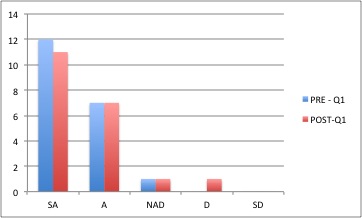
In a previous post ( https://kidsengineer.com/?p=572 ) I showed a graph of sixth grade attitudes towards computers/technology and engineering as a career. This results were pre/post surveys before and after a grade 6 robotics unit. The students had not experienced LEGO robotics before. The graphs seems to show a some significant gains in terms of interest in engineering as a possible career though some students went the other way as well.
Here’s the graph of question 1.
Q1 – I like using computers and other technology.
Strongly Agree Agree Neither Agree or Disagree Disagree Strongly Disagree
Here is question 2 and the associated graph.
Q2 – I would consider being engineer when I am older.
Strongly Agree Agree Neither Agree or Disagree Disagree Strongly Disagree
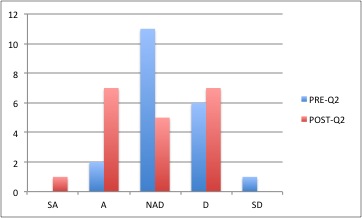
Even though it was a small sample, I was anxious to try my hand at data analysis using SPSS, a statistical tool I had not used before. I will report the data on question 2 only since it is clear from the graph that question 1 showed little change.
Paired Samples T-Test
p= .074 (N=19) t=-1.5, one-tailed
p <.05 is usually considered to be statistically significant so, though close, I could not show significance. p<.05 means that there is less than a 5% chance that the effect was due to chance.
I reran the data throwing out one response where the student reported a change in interest (negative, in this case) that was clearly not related to his school experience. In this case, p = .0235, which would be considered significant.
.0235 (N-18) t=-2.1, one-tailed
Note to statisticians, why is t negative if the numbers on my class increased (agree responses were coded higher than disagree responses).
While we can’t conclude much from such a small sample size either way, I do think that this preliminary data shows some significant movement in attitudes (mostly positive). While I first was only looking for positive changes in engineering interest, I now think that is in normal and natural for some kids to find it’s not for them, even though they seem to find the project fun and interesting. I do believe that with a larger sample with a good curriculum and teaching, there would be a statistically significant result from this simple survey. Looking at the qualitative data as well, some interesting questions emerge for evaluating interest in STEM careers at such a young age.
1) What is the best way to measure STEM interest? It is clear from some of the qualitative responses (“Why would you consider or not consider a career in engineering?”), that sixth grade students do not necessarily have a clear idea of what engineering is (despite some teaching of what it is and their experience with the project.) Most moved from thinking about engineering as building initially to designing and building at the end of the project.
2) Some students are not far from the “fantasy” age of career choices such as reporting low incidence possibilities so common in younger children.
3) In talking to kids about this, many give answers not rooted in their actual engineering experience (no matter how limited) but in other external factors.
It seems that a mixed quantitative and qualitative approach is needed to tease out this questions and how elementary and middle school age student think about career choices based on school experiences.
I will be presenting at the Tech in Education Conference in Holyoke, MA today. The slides can be found under Resources.
Here is some data from a grade 6 class I just finished working with. They were new to robotics. The pre/post survey asked 2 quantitative questions.
Q1 – I like using computers and other technology.
Strongly Agree Agree Neither Agree or Disagree Disagree Strongly Disagree
Q2 – I would consider being engineer when I am older.
Strongly Agree Agree Neither Agree or Disagree Disagree Strongly Disagree
Here are 2 graphs showing the results.
There was not much of an effect for Q1. Students’ views of using technology did not change significantly. Q2 showed a marked positive change in whether or not students would consider a career in engineering. Looking at individuals, some students went the other way too, which I now think is expected as some students find the engineering design process not for them.
I am just learning SPSS so I will post the statistics in the future. The qualitative data was also interesting. I’ll also report on that later as well.